The Drosophila Flight Simulator
 
The Drosophila Flight Simulator

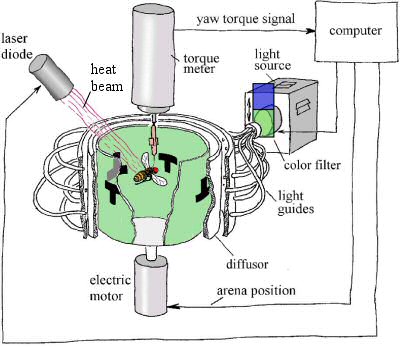
In the Drosophila flight simulator, a single fly, glued to a small hook of copper wire and attached to a torque meter, is flying stationarily in the center of a cylindrical panorama (arena). In the flight simulator mode (closed loop), the rotational speed of the arena is made proportional to the fly's recorded yaw torque around its vertical body axis. This enables the fly to stabilize the rotational movements of the panorama (i.e. to fly straight) and to adjust certain flight directions with respect to particular visual landmarks (patterns). Yaw torque and flight direction of the fly are recorded continuously and stored in the computer memory (sampling frequency 20 Hz).

The illumination of the arena can be colorized by inserting color filters (e.g. green and blue) between the light source and the light guides. The patterns on the inside of the arena wall can quickly be changed during the experiment. A laser diode provides an infra-red heat beam, which is unpleasant for flies.

Combined with heat reinforcement, the setup can be used for operant and classical conditioning, respectively. 

All possible contingencies between the fly's behavior, the visual cues and the reinforcer can be established in the flight simulator. One can think of at least for basic types of relations into which the three components (behavior, stimulus, reinforcer) can be brought: I. Classical conditioning, II. Pure operant conditioning, III. Parallel operant conditioning, IV. Facilitating operant conditioning. The theoretical background for this classification as well as a detailed explanation of the four types can be found at my general introduction. For a basic primer into the possibilities the flight simulator offers, see below:

In operant conditioning, the fly is flying in closed loop and the electric shutter opens whenever the fly brings one of the two pattern pairs into the frontal 90° sector of its visual field. The fly is punished by the heat beam and will eventually change its flight direction towards the other pattern, whereupon the shutter will close. After some minutes the fly will avoid the pattern previously associated with heat even when the heat is permanently switched off. In a similar manner flies can be trained to avoid one of two colors. The patterns are replaced by four identical vertical stripes. These denote the centers of four virtual quadrants. Whenever the fly turns the arena and enters a new quadrant, the color filter between the light source and the light guides changes the illumination of the entire arena from one color to the other. Training is conducted as in the pattern conditioning experiment: heat when the arena is illuminated with one color but not with the other. Flies quickly develop a preference for the unpunished illumination and keep that preference even when the heat is permanently switched off.

Classical conditioning is brought about by turning the arena in open loop (i.e. there is no feedback between the fly's control maneuvers and the rotational speed of the arena) with a constant rotational speed of 30°/s. The reinforcement regime is identical to the one described for operant conditioning: whenever one of the two patterns enters the frontal 90° sector of its visual field, the fly is punished by the heat beam. The shutter closes as soon as the next pattern is brought to the front. Classical color learning is conducted accordingly. After the open loop training the fly tested in closed loop for pattern (color) preference exactly as in the operant paradigm.


homelearningevolutionmetabiology