Operant Conditioning
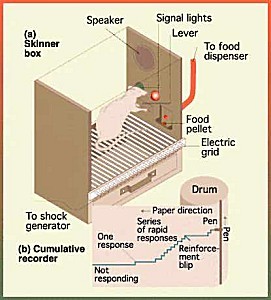
We use the term operant (or instrumental) conditioning to describe one type of associative learning in which there is a contingency between a behavior (BH) and the presentation of a biologically significant event (the "reinforcer", outcome or unconditioned stimulus: US). This situation resembles most closely the classic experiments from Skinner, where he trained rats and pigeons to press a lever in order to obtain a food reward ("Skinner-Box", see figure). In such experiments, the animal is able to generate certain motor-output, (e.g. running around, cleaning, resting, pressing the lever). The experimenter chooses a suited output (BH, e.g. pressing the lever) to pair it with a consequence (US, e.g. a food reward). Often a discriminative stimulus (SD, e.g. a light) is present, when the BH-US contingency is true. After a training period, the animal will show the behavior (BH, e.g. pressing the lever) even in absence of any reward, if the BH-US association has been memorized. Such instrumental or operant conditioning is different from Pavlovian or "classical conditioning", where the US presentations are independnt from the behavior of the animal, but instead is contingent upon environmental events. In my general introduction to simple associative learning, you can learn more about the differences between classical and operant conditioning. These concepts are incorporated into the framework of brains as output/input devices, outlining how brains use experience to make decisions of what behavior to produce next.
Martin Heisenberg and Reinhard Wolf have developed a general model of operant behavior, which joins a description of some more features of operant conditioning.
Based on these concepts, we have developed operant conditioning experiments which isolate the operant component (so-called self-learning experiments). Usin g operant self-learning, we have discovered that one root of the speech component of language can be traced to the conserved gene function of the gene FoxP. These experiments also reveal that Protein Kinase C is involved in this form of operant learning, while the canonical 'learning and memory' genes are not involved.